Philosophy
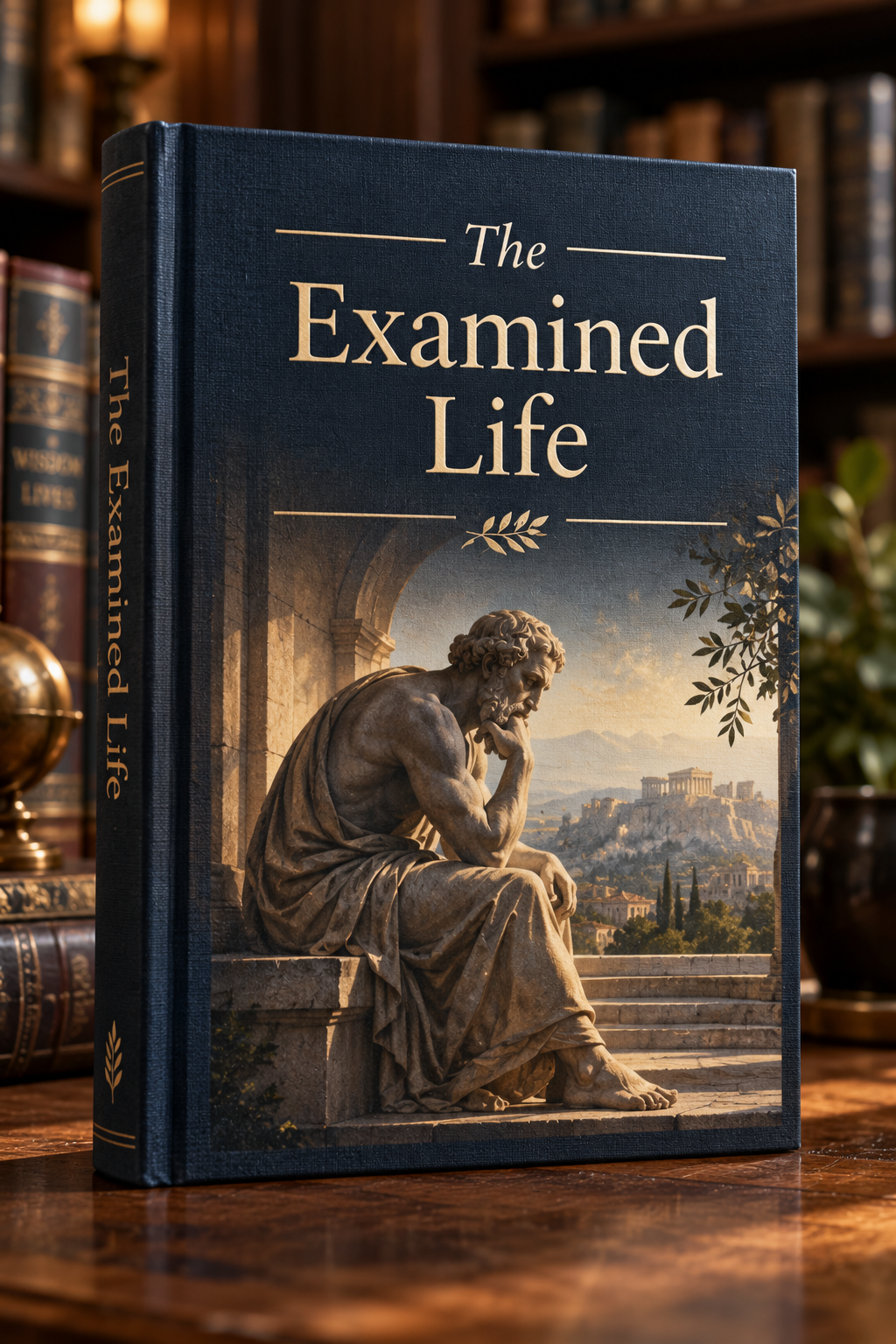
The Examined Life — Plato's Apology
A modern exploration of Socrates’ challenge to examine our beliefs, value character over reputation, and live according to principles we have genuinely chosen.
How to Live When Certainty Is Impossible
What’s in it for me?
Most of us spend enormous energy trying to succeed at life without spending much time deciding what success actually means. The examined life begins with a different question: before asking how to get more, achieve more or protect what you have, ask whether the things you are pursuing are genuinely worth pursuing.
The reward is not certainty. It is something more useful: the ability to live deliberately rather than simply inheriting your priorities from everyone around you.
Guiding Questions
- What if wisdom begins not with knowing more, but with recognising what you do not know?
- How much of your life is organised around things you have never seriously questioned?
- Is being respected more important than being right?
- What principles would you continue to defend if they became inconvenient?
- What would it mean to reach the end of your life knowing that you had actually lived according to your beliefs?
1. Wisdom begins when you stop pretending to know
One of the strangest forms of intelligence is knowing where your knowledge ends.
Human beings dislike uncertainty. We prefer confident answers, decisive opinions and people who appear to know what they are doing. Yet confidence and knowledge are not the same thing. Sometimes the most dangerous person in the room is not the person who knows little, but the person who knows little and believes they know a great deal.
Imagine two people standing at the edge of an unfamiliar forest.
One says, “I know exactly where we are going.”
The other says, “I think this is the right direction, but I could be wrong. Let’s check.”
The first sounds stronger. The second is probably safer.
That distinction matters far beyond navigation. We form confident beliefs about careers, relationships, politics, money, status and happiness. We say things such as “Once I reach that position, I’ll be satisfied,” or “People like that are always wrong,” without noticing how much assumption sits underneath the statement.
There is therefore a peculiar kind of strength in saying:
I don’t know.
It does not mean abandoning judgement. It means leaving enough space between yourself and your beliefs to test them.
A good mind does not treat uncertainty as an embarrassment. It treats uncertainty as the beginning of enquiry.
2. An unexamined belief quietly becomes a master
The beliefs that govern us most powerfully are often the ones we have never consciously chosen.
Consider what a successful life is supposed to look like. Perhaps it involves a larger house, an impressive job title, financial security, respected children, good holidays and the approval of people around you.
There is nothing inherently wrong with any of those things.
But there is a profound difference between wanting something because you have considered it carefully and wanting it because everyone around you seems to want it.
Imagine spending twenty years climbing a ladder, only to arrive at the top and realise it was leaning against the wrong building.
The problem is not the climbing.
The problem is never looking up.
Examining your life therefore means periodically interrogating your own priorities.
Why do I want this?
Where did that belief come from?
Would I still want it if nobody else knew I had achieved it?
What am I sacrificing to obtain it?
These questions can be uncomfortable because they threaten the invisible agreements around which our lives are built. Careers, social circles and even identities can depend upon assumptions we have rarely challenged.
But that discomfort is valuable.
It is the sensation of moving from a life that simply happened to you towards a life you have consciously chosen.
3. Your character matters more than your reputation
There is a powerful temptation to optimise life around how we appear to others.
We want to look successful, intelligent, respectable and competent. Modern life makes this particularly easy because reputation is constantly measurable: job titles, salaries, followers, houses, qualifications and achievements all provide visible signals of how well we seem to be doing.
But appearance and reality can quietly drift apart.
You can look successful while becoming someone you do not particularly admire.
You can win an argument through cleverness while knowing that your opponent was right.
You can protect your reputation by avoiding an uncomfortable truth.
The harder question is not:
What will people think of me?
It is:
What kind of person am I becoming?
Suppose admitting a mistake damages your reputation temporarily but strengthens your honesty.
Or defending someone unpopular costs you social standing but preserves your sense of justice.
Or walking away from a lucrative opportunity makes you look foolish but prevents you doing something you believe is wrong.
From the outside, these choices may resemble losses.
Internally, they may be victories.
Reputation is partly controlled by other people. Character is the part that remains yours.
A useful test when facing a difficult decision is therefore to imagine that nobody will ever know what you chose.
No applause. No criticism. No LinkedIn announcement. No explanation afterwards.
Which decision would you respect yourself for making?
That answer often reveals what reputation has been hiding.
4. A good life requires the courage to be inconvenient
Principles are easy to hold when they cost nothing.
Almost everyone values honesty until honesty threatens their career. Almost everyone values loyalty until loyalty becomes inconvenient. Almost everyone values courage until courage requires standing alone.
The real test of a belief is therefore not whether you can articulate it.
It is whether it survives contact with consequences.
Imagine someone who insists that they believe in speaking truthfully, but repeatedly stays silent whenever honesty might upset an important person.
Over time, the gap between belief and behaviour becomes a kind of quiet self-deception.
The person still thinks of themselves as honest.
Their behaviour tells a different story.
This is why examining a life cannot remain purely intellectual. Eventually the ideas have to encounter reality.
You might say that integrity is the point where your stated values and your actual behaviour meet.
And that meeting point is rarely comfortable.
Sometimes living according to your principles makes life harder rather than easier. You may lose opportunities. People may misunderstand you. You may have to admit that something you once believed was wrong.
But there is also a strange freedom in this.
If your behaviour is controlled primarily by other people’s approval, you are permanently negotiating with the crowd.
If it is controlled by principles you have examined and chosen carefully, you possess an internal compass.
The destination may still be uncertain.
At least you know what you are steering by.
5. Questioning yourself is more valuable than defending yourself
When someone challenges one of our beliefs, our instinct is usually defensive.
We gather evidence supporting our position. We look for weaknesses in theirs. We remember examples proving that we were right.
The mind becomes a lawyer.
But intellectual growth requires it occasionally to behave more like a detective.
The lawyer asks:
How can I prove my case?
The detective asks:
What actually happened?
That difference sounds small, but it changes everything.
Suppose you believe someone at work is unreliable. Every missed deadline becomes further evidence. Every successful delivery becomes an exception.
Soon you are no longer investigating your belief. You are maintaining it.
A better question is:
What evidence would convince me that I am wrong?
If the answer is “nothing”, you no longer hold a conclusion.
You hold a commitment.
The examined life therefore involves regularly turning your questioning back upon yourself.
Perhaps your judgement is correct.
But perhaps the person you are interrogating most rigorously should occasionally be the person in the mirror.
That habit protects against one of the great dangers of intelligence: becoming increasingly skilled at explaining why you were right all along.
6. Fear becomes smaller when you ask what is actually worth protecting
Many of our decisions are shaped by fear: fear of losing status, money, security, relationships, opportunities or even life itself.
Some of those fears are entirely reasonable.
But fear has a tendency to flatten our priorities. When something feels threatening, simply avoiding the threat can begin to feel like the highest possible objective.
Yet survival, comfort and reputation are not automatically the most valuable things in every situation.
Imagine being offered a choice between preserving your position through an act you consider deeply dishonest and losing the position while keeping your integrity.
The immediate calculation points towards safety.
The larger calculation asks what exactly safety is for.
If preserving your life requires abandoning everything that gives that life meaning, something has gone wrong with the calculation.
This does not require recklessness. Sensible people protect themselves and the people they love.
But fear deserves examination just like every other belief.
Ask:
What exactly am I afraid of losing?
Why does that matter?
What would I become if avoiding that loss became my overriding priority?
Sometimes courage does not mean feeling less afraid.
It means discovering that something else matters more.
7. The purpose of examining life is not to find perfect answers
There is an irony at the heart of serious reflection: the more carefully you examine life, the less likely you are to believe that everything can be settled conclusively.
The destination is not a perfectly completed philosophy of life.
It is a way of living.
You question your assumptions. You test your priorities. You notice when reputation is pulling you away from character. You challenge your own certainty. You decide which principles deserve loyalty when they become expensive.
Then life changes.
And you examine them again.
Think of it less like writing a rulebook and more like navigating a ship.
You choose a direction. You steer towards it. Wind and currents move you. New information appears. You correct your course.
The sailor who constantly checks the compass is not indecisive.
They are precisely the person most likely to reach the destination.
The same is true of a life.
Reflection is not something you finish before living begins.
Reflection is part of living well.
Closing Insight
The examined life begins with a deceptively simple act: refusing to live entirely on assumptions.
You may never become certain about what makes a good life. Perhaps nobody can. But you can become increasingly clear about what you value, increasingly alert to your own self-deception and increasingly willing to make your actions match your beliefs.
The important question is not whether you have discovered all the answers.
It is whether you have chosen the questions carefully enough that, over a lifetime, they keep pointing you towards the person you want to become.